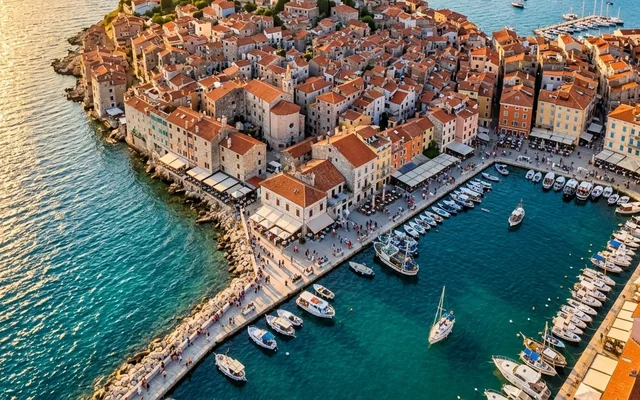
In short: in Rovinj it is worth seeing the church and bell tower of St Euphemia (62 m, the tallest in Istria), the picturesque Grisia street with its galleries, the old town on the peninsula and the Zlatni Rt forest park.
Rovinj is reckoned the most romantic town in Istria — the old town is built on a peninsula, with narrow stone lanes climbing towards the Church of St Euphemia, while fishing boats and islets drift off the harbour. In this guide we go through the beaches, sights and excursions, and if you are also interested in the Belgrade to Rovinj minibus transfer, how to get there is at the end.
Beaches in Rovinj
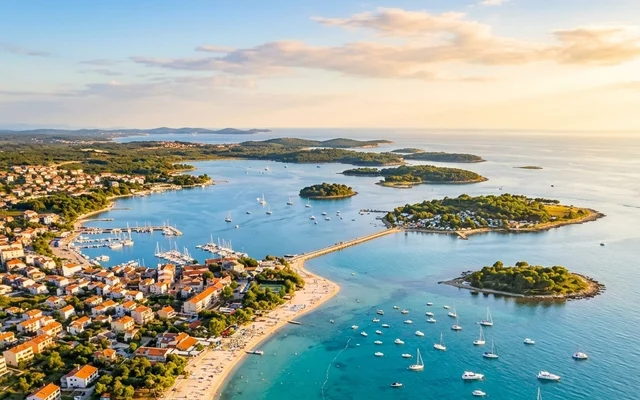
Rovinj’s beaches are mostly rocky and pebbly, in the shade of pines, with a clear sea. The largest and most visited is in the Zlatni Rt (Punta Corrente) forest park, south of the old town, with a view of the island of St Andrew. Alongside it, the renovated Lone and Mulini coves by the hotels are popular, as are the family-friendly Kuvi in a pine wood three kilometres from the centre, the wild Cisterna with its sandy bottom and the small Baluota by the old town, a favourite for the sunset. Off the town lie the island of St Catherine and the Red Island (St Andrew), reached by water taxi. For sandy beaches and shallow water, families usually choose the south of Istria — see what to see in Medulin.
What to see in Rovinj and nearby
The Church and bell tower of St Euphemia
The symbol of the town is the Baroque Church of St Euphemia at the top of the peninsula, with a bell tower 62 metres high — the tallest in Istria. The tower was built after the model of the famous Campanile of St Mark in Venice, and on its top stands a copper statue of the saint (about 4.7 m, from 1758) that turns with the wind. The climb up to the church is rewarded with a view of the red roofs and the sea.
The old core and Grisia
A web of narrow lanes leads to the top, and the loveliest is Grisia — a steep cobbled street full of galleries and studios, which every summer becomes an open-air town exhibition. A walk through the old core, past arches, balconies and stone houses, is the main experience of Rovinj.
The House of the Batana (UNESCO)
By the large jetty is the Batana Eco-Museum, the first eco-museum in Croatia, dedicated to the batana — the traditional Rovinj wooden flat-bottomed boat. In 2016 the batana was inscribed on the UNESCO register of good safeguarding practices for intangible heritage, and in summer the museum hosts evenings with traditional Rovinj music and local cuisine.
Zlatni Rt and excursions
Zlatni Rt is a park-forest with pines, cypresses and cycle paths right by the sea. Nearby are the Lim Bay and neighbouring towns — more about them in the guides what to see in Vrsar and what to see in Pula, and on the eastern coast there is also Rabac, all easily reached from Rovinj.
Rovinj for families and with children
The old town is lively for a walk, and a boat trip to St Catherine or the Red Island is especially interesting for children. As the town beaches are mostly rocky, families with small children often choose the well-kept bathing areas of Zlatni Rt or nearby places with a shallower entry into the sea.
Where to eat in Rovinj
Along the harbour and in the lanes of the old town there is a string of taverns with fresh fish and seafood, and Istrian cuisine brings pršut (prosciutto), truffles, olive oil and wines such as Malvazija and Teran. An evening with a view of the sea is the town’s main culinary experience.
How to get to Rovinj from Belgrade
For the Belgrade to Rovinj minibus transfer we drive door to door, departing from Belgrade. Departure is at night, at around 23:00h for Croatia, so the border is crossed when queues are smallest and you reach Rovinj in the morning. The journey is about 640 km, a drive of 7–8 hours.
The price is fixed and free of hidden costs — see the price for Rovinj or the whole price list, and we also drive to all the other towns in Istria (Belgrade to Istria transfer). Before the trip, check the border crossings and live cameras too, and read about the whole region in the guide Istria holidays.
Frequently asked questions
What are the beaches in Rovinj like?
Mostly rocky and pebbly, in the shade of pines, with a clear sea. The best kept are in the Zlatni Rt forest park, and off the town are the islands of St Catherine and the Red Island, reached by boat.
What to see in Rovinj?
The Church and bell tower of St Euphemia (62 m, the tallest in Istria), the picturesque Grisia street with its galleries, the old core on the peninsula and the Zlatni Rt forest park.
How tall is the bell tower of St Euphemia?
62 metres — it is the tallest bell tower in Istria, built after the model of the Campanile of St Mark in Venice, with a statue of the saint on top that turns with the wind.
Is Rovinj good for children?
It is for walks and boat trips to the surrounding islands; as the town beaches are rocky, families with small children choose the well-kept bathing areas of Zlatni Rt or nearby places with a shallower entry.
When is the best time for Rovinj?
The bathing season runs from late May to mid-September. The peak is in July and August, when the sea is warmest and the town liveliest; for a quieter break and finer light for photos, June and September are chosen.
How many days to set aside for Rovinj?
Two to three days are enough for the old town and beaches, and with excursions to the Lim Bay, Vrsar and Poreč it is pleasant to stay a week.
How far is Rovinj from Belgrade?
About 640 km, a drive of 7–8 hours. With a night departure from Belgrade (around 23:00h), you reach Rovinj in the morning.