In short: a minibus transfer from Serbia to Croatia crosses the border at Batrovci — Bajakovo, departing from Belgrade at around 23:00 and reaching the coast in the morning. The journey to Istria takes 7–8 hours, runs door to door, and costs from €75 per person one way.
Getting from Serbia to the Croatian coast means one border and the full width of Croatia — from Slavonia to the Adriatic. This guide explains what that journey looks like: how long it takes, where the border is crossed, which documents you need and what it costs.
How the minibus transfer from Serbia to Croatia works
The departure point is Belgrade, from where we drive straight to the Croatian coast — travellers from other parts of Serbia join in Belgrade. We travel by night, in one go, with no changeovers and no stops at bus stations.
The vehicles are air-conditioned, with WiFi and room for luggage at no extra charge. Your driver contacts you the day before departure to confirm the exact pick-up time.
Door-to-door transfer from Serbia to Croatia
We collect you at your address in Belgrade and drop you off in front of your accommodation in Croatia. There is no carrying luggage to a station, no changeover along the way and no taxi at the other end — and it is precisely those hidden costs that make the gap with a bus ticket smaller than it looks. We set out how such a journey works in the guide on the door-to-door minibus transfer.
The route and the Batrovci — Bajakovo crossing
The route follows the motorway from Belgrade to the border, which is crossed at Batrovci — Bajakovo, the busiest crossing towards Croatia. From there it continues through Slavonia and on towards the Adriatic, reaching either Kvarner or, further on, Istria.
Unlike the route to Greece, only one border is crossed here, so the journey takes less time than the same distance southwards. Departure is at night, around 23:00, so the border is crossed when queues are at their smallest. Before travelling it is worth checking the border crossings and live cameras.
Documents for travelling from Serbia to Croatia
Croatia has been in the Schengen Area since 2023, so a valid biometric passport is required — an ID card is no longer enough. Every child needs their own passport, and minors travelling without both parents should carry a notarised consent form. From April 2026 the EU Entry/Exit System (EES) also operates, recording a photograph and fingerprints on the first crossing.
More on documents and what to pack: documents and the border checklist.
Minibus transfer Serbia to Croatia: how long the journey takes
The time depends on how far west the destination lies:
- Kvarner — Rijeka about 552 km, Opatija about 565 km, 7–8 hours.
- Istria — Rabac about 615 km, Rovinj about 640 km, Pula about 655 km, 7–8 hours.
Because the departure is at night, you sleep through most of the journey and arrive in the morning, in time for your first day on the beach.
Where we drive in Croatia
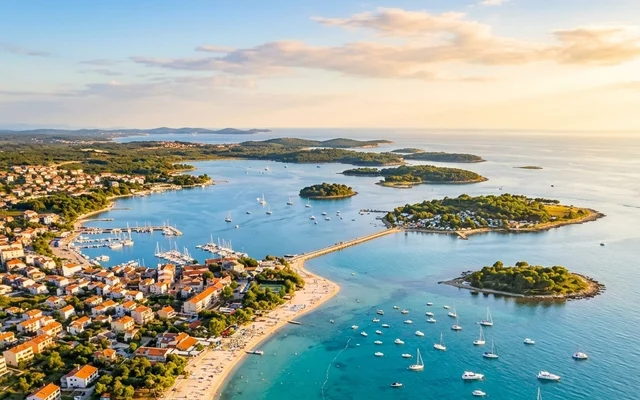
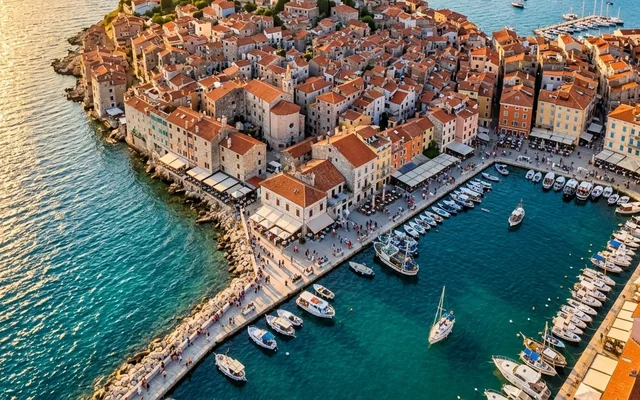
We cover two regions. Istria (Belgrade to Istria transfer) is the larger one, with eleven towns along the western and eastern coasts — from Umag (Belgrade to Umag transfer) and Novigrad in the north, through Poreč (Belgrade to Poreč transfer), Vrsar and Rovinj (Belgrade to Rovinj transfer), to Pula (Belgrade to Pula transfer), Medulin and Premantura in the south, and Rabac (Belgrade to Rabac transfer) on the eastern coast. Kvarner (Belgrade to Kvarner transfer) covers Rijeka (Belgrade to Rijeka transfer) and Opatija (Belgrade to Opatija transfer).
The full offer is on the Belgrade to Croatia minibus transfer page. Istria is also notable for its Blue Flag beaches — 43 beaches and six marinas (2025).
Minibus transfer Serbia to Croatia: price per person
The amount is per person, one way, with no hidden costs: from €75 for Kvarner and from €85 for Istria. A return ticket costs less than two one-way tickets, and there are better terms for children under two and for groups of four or more.
Payment is made to the driver on the day of departure, with no deposit. All prices are on the price list, and what the amount depends on is explained in the guide on how much a minibus transfer costs.
Frequently asked questions
How much does a transfer from Serbia to Croatia cost?
From €75 per person one way for Kvarner (Rijeka, Opatija) and from €85 for the Istrian towns. Exact amounts per town and return fares are on the price list.
How many borders are crossed on the way to Croatia?
Only one — the Serbian-Croatian border at Batrovci — Bajakovo. That is why the journey is shorter than to Greece, where two are crossed.
How long does the minibus journey to Istria take?
About 7–8 hours depending on the town — Rabac is about 615 km, Rovinj 640 km and Pula 655 km. With a night departure at 23:00 you sleep through most of it.
Is an ID card enough for Croatia?
No. Croatia has been in the Schengen Area since 2023, so a valid biometric passport is required, and every child needs their own.
Do you drive from other towns in Serbia?
The departure point is Belgrade, from where we drive straight to the Croatian coast. Travellers from elsewhere join in Belgrade — get in touch for advice on reaching the departure point.