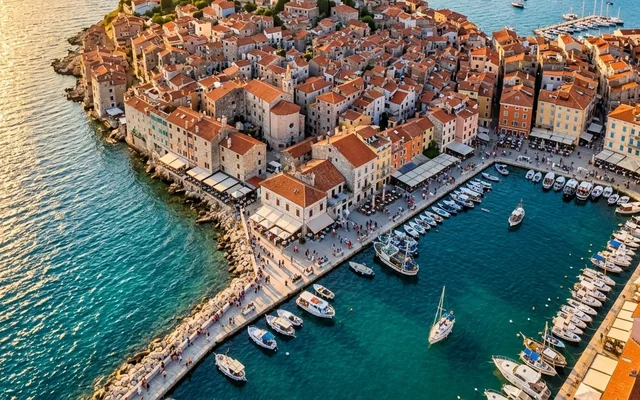
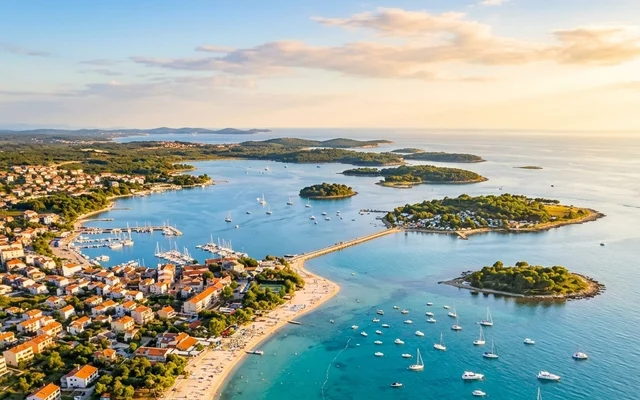
In short: in Pula it is worth seeing the Roman Arena (one of the best-preserved amphitheatres in the world), the Temple of Augustus on the Forum, the Arch of the Sergii and the old town, and for swimming the beaches of the Verudela peninsula.
Pula is the largest town in Istria and a town of Roman heritage — from the Arena, one of the best-preserved amphitheatres in the world, to the Temple of Augustus and the Arch of the Sergii in the old core. It also has the lovely beaches of the Verudela peninsula. In this guide we go through the sights, beaches and excursions; if you are also interested in the Belgrade to Pula minibus transfer, how to get there is at the end.
Beaches in Pula and nearby
The best known for swimming are the beaches of the Verudela peninsula, south of the centre. Hawaii beach (Havajska) is known for its white pebbles and turquoise sea among the rocks, while Ambrela is a cove with a Blue Flag and a shallow, gradual entry — ideal for families. A Blue Flag is also flown by the town beach Valkane along the Lungomare promenade, and peace and shade are offered by Gortanova cove. The beaches are mostly rocky and pebbly, with well-kept bathing areas. The loveliest wild beaches are a little further south, on the protected Cape Kamenjak — more about them in the guide what to see in Premantura.
What to see in Pula
The Pula Arena (amphitheatre)
The Arena is a Roman amphitheatre from the 1st century, built in the time of Emperor Vespasian, at the same time as the Colosseum in Rome. By size it is the sixth-largest preserved Roman amphitheatre in the world, and the only one whose all three architectural orders are fully preserved. It once held more than 20,000 spectators, and today it is the stage for concerts and a film festival. The visit also includes the underground passages.
The Temple of Augustus and the Forum
On the main square, the Forum, stands the Temple of Augustus — one of the best-preserved Roman temples, built in the early 1st century (between 2 BC and AD 14) in honour of Emperor Augustus and the goddess Roma. The Forum has been the centre of town life from antiquity to this day.
The Arch of the Sergii (the Golden Gate)
The Arch of the Sergii, also known as the Golden Gate, is an exceptionally well-preserved Roman triumphal arch from the late 1st century BC. The main pedestrian street of the old town starts from it.
Zerostrasse and the Kaštel
Beneath the Kaštel hill, the Austro-Hungarian fortress in the heart of the town, spreads Zerostrasse — a network of underground tunnels about 400 metres long, dug during the First World War as a shelter from air raids. Today they are laid out for visitors, with a constant temperature of around 14–18 °C, and at the top of the Kaštel is the Historical and Maritime Museum of Istria, with a view of the town, the harbour and the Arena.
Excursions from Pula
Nearby are excursions to the Brijuni from Fažana and to Medulin in the south, further north to Rovinj, and on the eastern coast of Istria there is also Rabac.
Pula for families and with children
The Arena and the ancient sights are interesting for children to look around, and a special experience is the Pula Aquarium on Verudela — set in a 19th-century Austro-Hungarian fortress, with Adriatic habitats, a shark pool and a rescue centre for sea turtles. Swimming at the well-kept beaches of Verudela, with sun loungers and bars, suits families. For shallow water and sandy beaches, the south of Istria (Medulin) is close by, and a boat trip to the Brijuni from neighbouring Fažana is a favourite family experience.
Where to eat in Pula
In the old town and along the fishing harbour there is a string of taverns with fresh fish and seafood, alongside Istrian specialities — pršut (prosciutto), truffles, fuži, olive oil and Malvazija and Teran wines. The market in the centre is good for local produce.
How to get to Pula from Belgrade
For the Belgrade to Pula minibus transfer we drive door to door, departing from Belgrade. Departure is at night, at around 23:00h for Croatia, so the border is crossed when queues are smallest and you reach Pula in the morning. The journey is about 655 km, a drive of 7–8 hours.
The price is fixed and free of hidden costs — see the price for Pula or the whole price list, and we also drive to all the other towns in Istria (Belgrade to Istria transfer). Before the trip, check the border crossings and live cameras too, and read about the whole region in the guide Istria holidays.
Frequently asked questions
From which century is the Arena in Pula?
From the 1st century — it was built in the time of Emperor Vespasian, at the same time as the Colosseum in Rome. It is the sixth-largest preserved Roman amphitheatre in the world and the only one with all three architectural orders fully preserved.
What to see in Pula?
The Roman Arena, the Temple of Augustus on the Forum, the Arch of the Sergii (the Golden Gate) and the old core; for swimming, the beaches of the Verudela peninsula.
What are the beaches in Pula like?
Mostly rocky and pebbly, best kept on the Verudela peninsula (the Ambrela and Hawaii coves, Blue Flag). The wild beaches are on the nearby Cape Kamenjak by Premantura.
What can be visited from Pula?
The Brijuni by boat from neighbouring Fažana, the protected Cape Kamenjak by Premantura, as well as nearby Medulin and Rovinj further north.
When is the best time for Pula?
The bathing season runs from late May to mid-September. July and August are the hottest and liveliest, with the most going on and festivals, but also the biggest crowds; June and September offer more pleasant temperatures, fewer crowds and better-value accommodation.
How many days to set aside for Pula?
Two to three days are enough to see the Arena and the ancient core, and if you add the Brijuni, Cape Kamenjak and the nearby beaches, it is nice to set aside a whole week.
How far is Pula from Belgrade?
About 655 km, a drive of 7–8 hours. With a night departure from Belgrade (around 23:00h), you reach Pula in the morning.