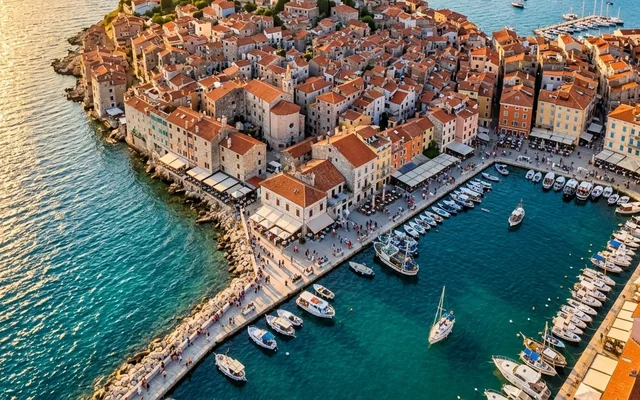
In short: the loveliest beaches of Istria are Cape Kamenjak near Premantura, the sandy Bijeca in Medulin, the Zlatni Rt in Rovinj and the coves around Rabac — mostly pebbly and well kept, with many Blue Flags.
Istria has the most indented coast on the Adriatic and one of the greatest concentrations of landscaped beaches in Croatia — 43 beaches and 6 marinas hold a Blue Flag (2025). From the sandy Bijeca for children, through Zlatni Rt in Rovinj, to the wild coves of Kamenjak — in this guide we go through the loveliest beaches by place. If you are also planning a Belgrade to Istria minibus transfer, how to get there is at the end.
Sandy beaches and beaches for children — Medulin
Istria is mostly rocky and pebbly, so genuine sandy beaches are rare and sought after. The best known is Bijeca in Medulin (Belgrade to Medulin transfer), over a kilometre long, with a shallow sea and a gradual entry surrounded by pines — a paradise for families with small children. Alongside Bijeca, the south of Istria also offers the Kašteja peninsula with well-kept bathing areas.
Rovinj and the Zlatni Rt forest park
Rovinj (Belgrade to Rovinj transfer) has some of the loveliest beaches in Istria, mostly in the shade of the pines of the Zlatni Rt (Punta Corrente) forest park. The Lone cove flies a Blue Flag, in the middle of a protected wood, and beside it are Mulini, the family-friendly Kuvi and the wild Cisterna. Off the town are the island of St Catherine and the Red Island, reached by water taxi.
Pula and Verudela
Pula (Belgrade to Pula transfer) has its best-known beaches on the Verudela peninsula, where seven bathing areas are lined up along about two kilometres of coast — Hawaii (Havaji), Ambrela, Plava plaža, Histria, Bambi and Saccorgiana, many with a Blue Flag. Nearby are the Stoja and Valkane coves, favourites with the locals. Neighbouring Fažana (Belgrade to Fažana transfer) is a quiet fishing town and the departure point for the Brijuni National Park.
Premantura and Cape Kamenjak
At the very south of Istria, Premantura (Belgrade to Premantura transfer) is the gateway to the protected Cape Kamenjak — an area about 30 km long, with wild rocky beaches, hidden coves and a crystal sea. The windy coves draw lovers of kitesurfing and windsurfing, and the untouched nature draws those escaping the crowds.
Poreč, Funtana and Vrsar — the laguna and pines
Poreč (Belgrade to Poreč transfer) is a well-appointed resort centre with the Plava (Blue) and Zelena (Green) Laguna — zones with bathing areas, pines and all the necessary infrastructure. Further south are quieter Funtana (Belgrade to Funtana transfer) with beaches surrounded by pines and Vrsar (Belgrade to Vrsar transfer) at the entrance to the scenic Lim Bay, with an archipelago of islets off the coast.
Umag and Novigrad — the north of Istria
In the north, Umag (Belgrade to Umag transfer) has a long landscaped coast with a promenade along the marina and a string of bathing areas towards Savudrija. Neighbouring Novigrad (Belgrade to Novigrad transfer) is a picturesque fishing town with a calm shore suitable for families and excellent food.
Rabac — the eastern coast
On the eastern, Kvarner side of Istria lies Rabac (Belgrade to Rabac transfer), known for its white pebble beaches and clear sea. The best known is Girandella, a beach with a Blue Flag and a view of the Kvarner bay and the island of Cres. Above the town rises the old mining town of Labin.
Blue Flags and how to get to Istria from Belgrade
With 43 beaches and 6 marinas under a Blue Flag, Istria is among the leaders on the Adriatic for the quality and upkeep of its coast. For the Belgrade to Istria minibus transfer we drive door to door, with a night departure from Belgrade (around 23:00h) and the Batrovci – Bajakovo border crossing; the journey is about 640–665 km, a drive of 7–8 hours, so you reach the coast in the morning.
The price is fixed and free of hidden costs — see the price list and all the towns in Istria (transfer to Istria). Before the trip, check the border crossings and live cameras, and read about the whole region in the guide Istria holidays.
Frequently asked questions
Which are the loveliest sandy beaches in Istria?
The best known is Bijeca in Medulin — sandy, shallow and over a kilometre long, ideal for children. Istria is otherwise mostly rocky and pebbly, so sandy beaches are rare and sought after.
How many Blue Flags does Istria have?
In 2025, Istria had 43 beaches and 6 marinas with a Blue Flag, among the most on the Croatian part of the Adriatic.
Which beach is best for children in Istria?
Bijeca in Medulin, for its sandy bottom and shallow sea with a gradual entry. The well-kept parts of Zlatni Rt in Rovinj and the lagune near Poreč are suitable too.
Where are the loveliest wild beaches in Istria?
On Cape Kamenjak by Premantura — a protected area about 30 km long with hidden coves, rocky beaches and a crystal sea.
What are the beaches in Rabac like?
White pebble beaches with a clear sea on the eastern coast of Istria; the best known is Girandella with a Blue Flag and a view of the Kvarner and the island of Cres.
How to get to the Istrian beaches from Belgrade?
By minibus, door to door, with a night departure from Belgrade (around 23:00h) via the Batrovci – Bajakovo crossing; you reach the coast in the morning, after 7–8 hours of driving.