In short, for summer 2026: in Croatia a coffee in a café costs roughly €1.80–3.50, the regulated fuel price is around €1.56/l for petrol and €1.71/l for diesel (revised every two weeks), parking in coastal town centres runs from €1 to €4 an hour, and there is no vignette — the road toll is charged by distance travelled. Below is a detailed breakdown of prices by category, with tips for saving.
Before you pack your bags, it is good to know what really awaits you on the spot — from pizza and coffee to fuel, parking and sun loungers on the beach. In this guide we give the rough prices in Croatia for summer 2026, with a focus on Istria and Kvarner, expressed in ranges because they differ from place to place and through the season. The prices are a guide for planning your budget, not fixed values.
Food and drink prices
Istria is widely regarded as the most gastronomically rich part of the Croatian coast, and it shows on the bill:
- Pizza — a slice from a bakery or pizzeria usually €3–5, a whole pizza at a restaurant €8–15.
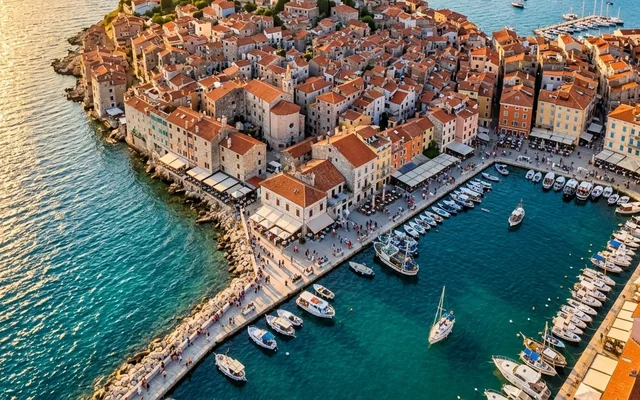
- A main course at a tavern — mid-range in Rovinj (Belgrade to Rovinj transfer), Pula (Belgrade to Pula transfer) and Poreč (Belgrade to Poreč transfer) €12–25 per person (fish specialities such as brudet or scampi buzara-style are usually €15–25 a portion); top-end restaurants can charge €60–100 per person for a multi-course meal.
- Coffee — roughly €1.80–3.50 in a café, espresso often over €2, cappuccino close to €3.
- Water and ice cream — considerably cheaper at the supermarket than on the promenade or the beach.
You save the most if at least one meal a day is at a tavern a little further from the main promenade — prices drop as soon as you move a couple of streets back from the sea.
Supermarket prices
If you prepare part of your meals yourself, shopping at the supermarket noticeably cuts the cost. The most widespread chains in Croatia are Konzum, Plodine, Lidl and Studenac — prices of basic groceries (bread, milk, fruit, vegetables) are similar to the wider region, and Lidl and Plodine are usually the most affordable. Water, soft drinks and snacks cost noticeably less at the supermarket than on the beach.
Cigarette prices
A pack of cigarettes in Croatia costs on average around €3.86 (median about €4.10), and the most popular brands cost between €4 and €4.60. Since 6 January 2026 a new, higher excise duty on tobacco products has been in force, so prices this season are somewhat higher than last summer.
Fuel prices
Fuel in Croatia is partly regulated — the government sets a maximum retail price, and a new price takes effect every two weeks (on Tuesdays). According to the latest published regulated price (from 11 August 2026), petrol (Eurosuper 95) is around €1.56/l, and diesel (Eurodiesel) around €1.71/l; the Croatian Auto Club (HAK) notes that at some stations, most often beside the motorway, prices can reach €1.88/l for petrol and €2.20/l for diesel. If you are travelling by your own car, it pays to fill up away from motorway service stations.
With the Belgrade to Croatia minibus transfer you do not worry about fuel or tolls — that cost is already included in the price, so you can leave this item out of your budget entirely.
Road tolls — no vignette, charged by distance
Unlike Slovenia, Croatia has no vignette. The road toll on Croatian motorways — including the Istrian A8/A9 motorway, run by the concessionaire Bina-Istra — is charged according to the distance travelled, via an electronic ENC device or at toll booths. By the end of 2026 Croatia plans to move to a fully electronic, stop-free toll system, but the principle stays the same — you pay for the distance you actually drive, not a fixed annual or weekly amount as with the vignette in Slovenia or Austria. For passengers on our minibus, this cost is already included in the ticket price.
Sun loungers and parasols on the beach
At ordinary town beaches in Istria and Kvarner, a pair of sun loungers with a parasol is most often roughly €25–40 a day. At more exclusive spots, particularly the beach bars of upmarket hotels in Rovinj, the price can jump to €100–160 a day — these are the exception, not the rule. Many public beaches still offer free space for your own towel, so with a little planning it is easy to save here.
Parking in coastal towns
Parking in the centres of Istrian towns is not cheap in summer and is worth factoring into your budget:
- Rovinj (transfer to Rovinj) — €1.50–3 an hour depending on the zone, a day ticket around €25.
- Poreč (transfer to Poreč) — €1–2 an hour, a day ticket around €20.
- Pula (transfer to Pula) — €1.20–4 an hour depending on the zone, with a maximum stay of two hours in the strictest zones.
Prices are higher in summer than out of season, and the most expensive zones are, as a rule, those closest to the old town and the sea. Similar parking rules apply in other coastal towns, including Rijeka (Belgrade to Rijeka transfer) and Opatija (Belgrade to Opatija transfer) on Kvarner.
Tourist tax on accommodation
The tourist tax in Croatia is paid by the guest per person and per night, and the amount depends on the category of the place and the time of year — it is higher in season than out of season. For summer 2026, under the official decision for Istria, the rough amounts per night are: Rovinj (category B) €1.60 in season / €1.06 out of season, Poreč (category C) €1.06 in season / €0.66 out of season. Children under 12 are exempt, and those aged 12–18 pay half the amount. The tax is usually paid on the spot and is rarely included in the accommodation price on booking platforms.
How to make the holiday cheaper
A few small things save the budget: choose a tavern a couple of streets back from the promenade, buy part of your groceries at the supermarket, park outside the strictest (and most expensive) zones or use public transport in town, and factor the tourist tax into your plan in advance. The biggest difference, however, is made by the transfer itself — our Belgrade to Croatia minibus transfer has a fixed price with no hidden costs (fuel, the toll and the border are included), so you know in advance how much you are setting off with. The current prices per destination are in the price list, for example the price for Rijeka, the price for Umag, the price for Poreč or the price for Novigrad. For the full offer see the Istria (Belgrade to Istria transfer) and Kvarner (Belgrade to Kvarner transfer) pages, and before you set off, check the border crossings and live cameras.
Frequently asked questions
How much money a day do you need for Croatia in 2026?
It depends on your travel style, but roughly: with cooking part of your meals and an occasional meal at a tavern, it is realistic to reckon on fifteen to twenty euros per person a day for food and drink, plus parking and any sun loungers. Accommodation and the tourist tax are counted separately.
Is there a vignette in Croatia?
No — Croatia has no vignette. The road toll on motorways is charged according to the distance travelled, via an ENC device or at toll booths, unlike Slovenia and Austria where a fixed vignette is charged.
How much does coffee cost in Croatia?
Roughly €1.80–3.50 in a café, depending on the town and the type of coffee — espresso is usually cheaper than a cappuccino or macchiato.
How much does a pack of cigarettes cost in Croatia?
On average around €3.86 (median about €4.10), with popular brands up to €4.60. A higher excise duty took effect in January 2026, so prices are somewhat above last year’s.
Is the tourist tax included in the accommodation price?
Most often it is not — it is paid on the spot, per person and per night. It depends on the category of the place and the season, and children under 12 are exempt.