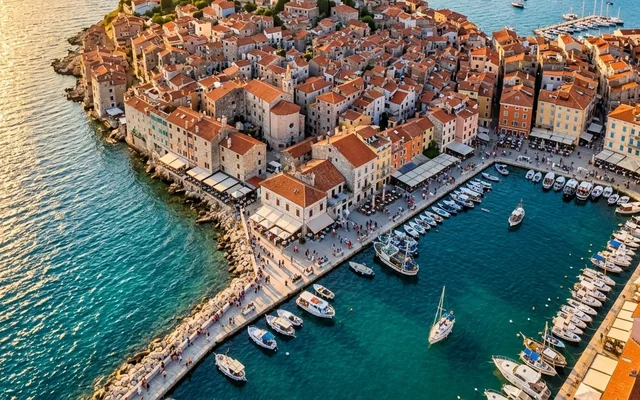
In short: in Poreč it is worth seeing the Euphrasian Basilica with its Byzantine mosaics (UNESCO), the ancient Decumanus street and the Marafor square, in an old town with a Roman street layout.
Poreč is one of the oldest and most visited towns in Istria, with an old core on a peninsula that still keeps its ancient street layout today. Its greatest symbol is the Euphrasian Basilica with its Byzantine mosaics, on the UNESCO list. In this guide we go through the sights, beaches and excursions; if you are also interested in the Belgrade to Poreč minibus transfer, how to get there is at the end.
Beaches in Poreč
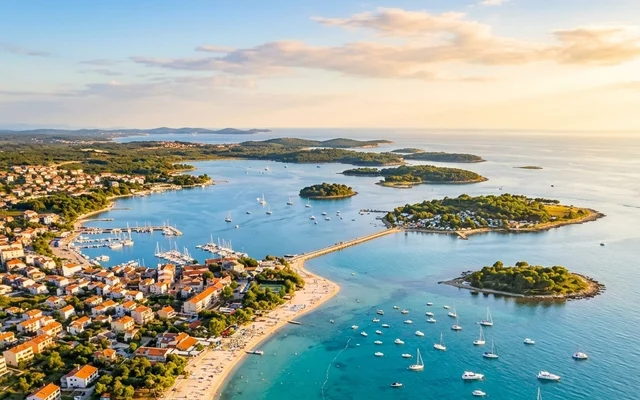
Poreč prides itself on the largest number of Blue Flags in Croatia — as many as eighteen along its coast. The beaches stretch along the tourist zones north and south of the town, most of all in the Zelena (Green) and Plava (Blue) Laguna, by the Bijela uvala (White Cove), and the Pical, Brulo and Borik beaches — well-kept bathing areas, mostly rocky and pebbly, with pines, promenades and water sports. The sea is clear, and the coast is good for long walks. Shallow sandy beaches are usually sought by families further south — more in the guide what to see in Medulin.
What to see in Poreč and nearby
The Euphrasian Basilica (UNESCO)
The Euphrasian Basilica was built in the 6th century, in the time of Bishop Euphrasius and Emperor Justinian, and in 1997 it was inscribed on the UNESCO World Heritage List. It is famous for the shining Byzantine mosaics in the apse, among the loveliest of their kind in Europe. The complex also includes a baptistery, a bell tower and the bishop’s palace.
The Decumanus and Marafor
The old core on the peninsula has kept its Roman street layout — the main one is the Decumanus, and the ancient square Marafor preserves the remains of Roman temples. Poreč, along with Pula, was the first Roman colony in Istria.
The Baredine cave
In the hinterland of Poreč, near Nova Vas, lies the Baredine cave — a geomorphological natural monument and one of the best-known landscaped caving sites in Istria. A laid-out path leads through halls adorned with stalactites and stalagmites, and the cave is home to the endemic olm (Proteus), a small underground amphibian of the Dinaric karst.
Excursions from Poreč
Nearby are picturesque towns and nature — the Lim Bay and neighbouring Vrsar, as well as Novigrad and Umag from the north, easily reached on an excursion.
Poreč for families and with children
The tourist zones of the Plava and Zelena Laguna offer well-kept bathing areas, water parks and water sports, so Poreč is popular with families. The old core is pedestrian and safe for a walk, and along the coast there are cycle and walking paths.
Where to eat in Poreč
In the old town and along the marina there is a string of taverns and restaurants with fish, seafood and Istrian specialities — pršut (prosciutto), truffles, fuži and Malvazija and Teran wines. The surrounding hinterland is known for its olive oil.
How to get to Poreč from Belgrade
For the Belgrade to Poreč minibus transfer we drive door to door, departing from Belgrade. Departure is at night, at around 23:00h for Croatia, so the border is crossed when queues are smallest and you reach Poreč in the morning. The journey is about 645 km, a drive of 7–8 hours.
The price is fixed and free of hidden costs — see the price for Poreč or the whole price list, and we also drive to all the other towns in Istria (Belgrade to Istria transfer). Before the trip, check the border crossings and live cameras too, and read about the whole region in the guide Istria holidays.
Frequently asked questions
What to see in Poreč?
The Euphrasian Basilica with its Byzantine mosaics (UNESCO), the ancient Decumanus street and the Marafor square, as well as the old core on the peninsula with its Roman street layout.
From which century is the Euphrasian Basilica?
From the 6th century, from the time of Bishop Euphrasius and Emperor Justinian. It was inscribed on the UNESCO World Heritage List in 1997 and is known for its preserved Byzantine mosaics.
What are the beaches in Poreč like?
Mostly rocky and pebbly, in the tourist zones of the Plava and Zelena Laguna, with pines, well-kept bathing areas and water sports; the sea is clear.
Is Poreč good for children?
It is — the tourist zones offer water parks, water sports and well-kept bathing areas, and the old core is pedestrian and pleasant for a walk.
When is the best time for Poreč?
The bathing season runs from late May to mid-September, peaking in July and August. June and September are more pleasant for exploring the town and the laguna, with fewer crowds and better-value prices.
How many days to set aside for Poreč?
Two to three days are enough for the town and the laguna, and with excursions to the Baredine cave, the Lim Bay and Vrsar it is nice to set aside a week.
How far is Poreč from Belgrade?
About 645 km, a drive of 7–8 hours. With a night departure from Belgrade (around 23:00h), you reach Poreč in the morning.